Cooling the Climate Quickly
The fastest, cheapest cooling lever we have is biological!

I’m writing this from Lisbon, where I am accidentally escaping the record heat dome that has moved over France and up to the Netherlands with record temperatures the climate models expected for 2050. I have encountered temperatures of 40 and above before in places like Rajasthan and Egypt and it makes you feel like you are inside an oven. Now these temperatures scorch Western Europe.
Carbon is not the only game in town!
For decades the world has believed that the climate problem is just a carbon problem. Parts per million in, parts per million out. It’s a clean story: you can put a price on a ton and trade it, and an entire apparatus of markets and policy has been built on top of it. And it isn’t wrong, it is a carbon problem. The trouble is the word only. It is not only a carbon problem, and the clean simplicity of the carbon story is precisely what blinds us to everything else in the frame. There’s a name for this now: carbon tunnel vision. The metric we can measure most easily has quietly become the only thing we look at. What it leaves out is the active cooling function by the biosphere that has diminished as well.
Nature cools!
Forests, soils, wetlands, the life in the ocean , together they form something close to a planetary air-conditioning system. They pump water inland. They seed the clouds that shade the land. They keep the small water cycle turning, wetting the interior of continents that would otherwise dry and bake. None of this shows up when you count only carbon. All of it is being switched off, ecosystem by ecosystem, and the heat that follows gets booked to the wrong account or to no account at all.
The story of a small valley in the tropics
Many of these effects I had already encountered, in miniature and up close, long before I could put physics to them. In 2010 I bought a largely deforested valley in the rainforest belt of Bahia with the aim to reforest and rewild it, letting forest return to ground that had been worn down to hard pasture. Nature was an amazing teacher. As trees grew back and clumps of bamboo grew at neck breaking, while we dug hole after hole to create small lakes and wetlands, the valley started to cool compared to surrounding areas. Soils softened, birdlife bounced back spectacularly, springs came back, the streams ran longer into the dry season, the afternoon air over the regrowing land stopped having that scorched, brittle quality, and the small rains grew more reliable. None of that was carbon. It was water and shade and the living processes that move them. The difference, valley to valley, was especially noticed by the people from the surrounding area who came to help with the change.
Cooling the Climate Quickly, the paper
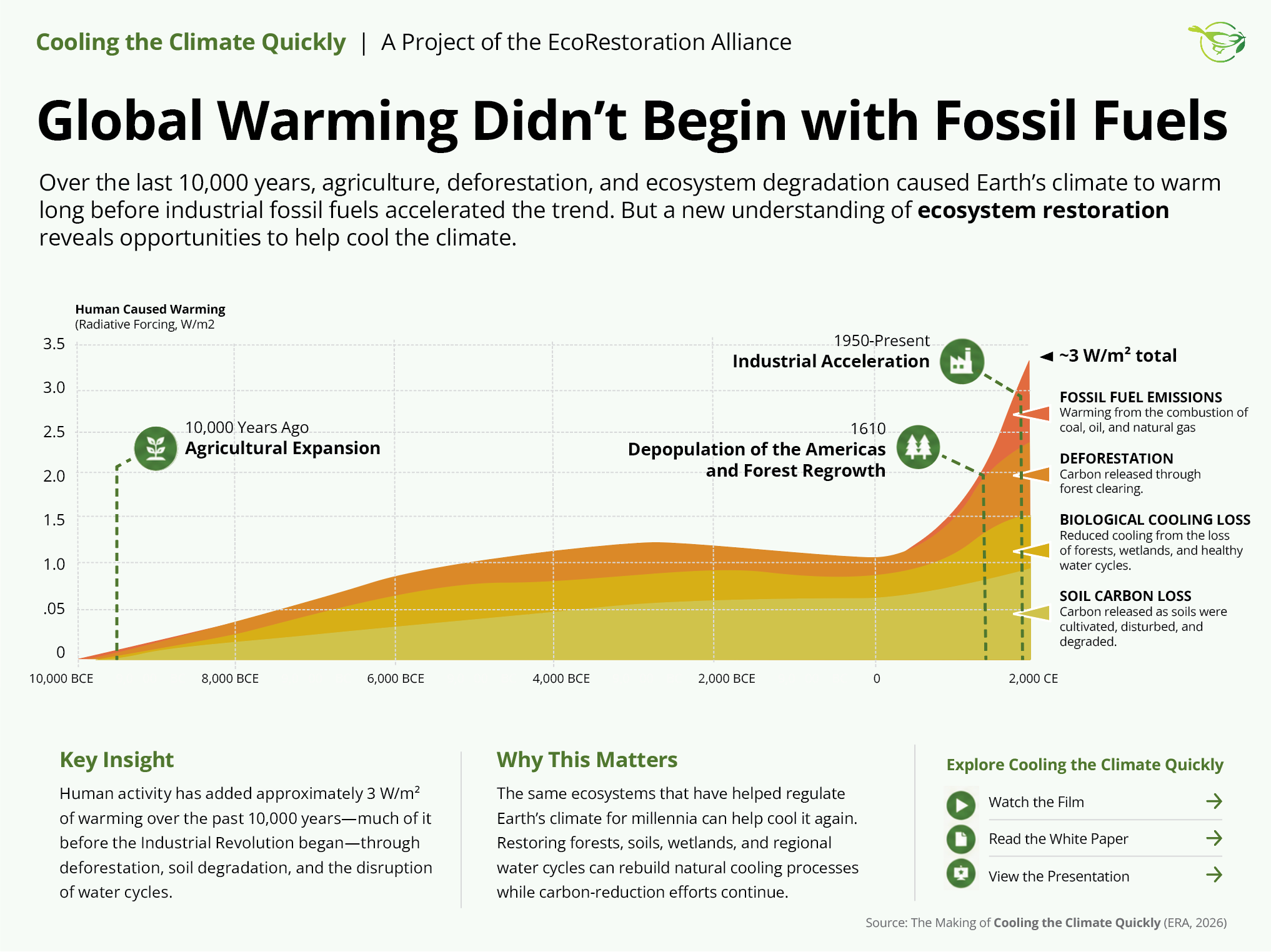
It was Jon Schull, chair of the EcoRestoration Alliance who, in part inspired by our book Cooling the Climate, brought together a group of people and ploughed through thousands of documents with AI to start and quantify the biophysical cooling effects of ecosystems on land and in the sea. I was honored to be part of that group that included people like Brian von Herzen, Peter Bunyard, Jon Schull, Didi Pershouse, Stuart Cowan, Howard Dryden and others to try and put numbers to in a whitepaper we call Cooling Climate Quickly. You can read the whole thing here. The numbers are not timid. Somewhere between 15 and 45 percent of today’s climate forcing traces not to fresh fossil emissions but to degraded living systems. Conventional carbon math undervalues restoration’s climate benefit by something like four to ten times. And restored ecosystems can deliver 2 to 4°C of local cooling fast, not decades, mainly through rehydration of the soils, increased growth and evapotranspiration, cloud forming and even rainfall.
Our earlier research
None of this surprised me when I saw it written down. Peter Bunyard and I had spent years on exactly these mechanisms for our book, Cooling the Climate; the water cycles, the cloud physics, the biology that moves heat around a planet. The figures only confirmed, in hard numbers, what the research had already made plain. In fact our own calculations of the biophysical cooling capacity of the rainforests was on the high side and scientific data showed us we needed to lower them. But they were still sufficient to show that a strategic regeneration of our planet’s ecosystems could stop the planet from heating up while we are slowly going through the process of decarbonization, so the worst case scenarios, leading to the collapse of human society worldwide, killing half the global population in the decades to come, could be avoided!
But I know how large and how hopeful they sound to someone meeting them for the first time, so let me offer the proof that tends to land hardest: an experiment we ran by accident, on the whole planet, without meaning to.
Accidental geoengineering woke the climate scientists up
In 2020, new rules abruptly cut the sulfur in shipping fuel. A clean-air victory, overdue. But the bright, reflective ship-track clouds that sulfur exhaust had been quietly painting across the oceans began to vanish. The shading dropped. The warming jumped measurably especially over heavy shipping routes, fast. We’d been geoengineering ourselves cooler without intending to, and the moment we stopped, the thermostat moved under our feet. Other factors played a role, particularly reduced cloud forming over the Amazon and Congo rainforests and adjacent oceans due to droughts induced by El Ninos. These factors were and still are not clearly mapped by mainstream climate science, but the diminished cloud forming due to the cleaner shipping fuel, were.
That’s when it landed. If thinning clouds a little can heat the planet that fast, restoring the biological machinery that brightens and seeds clouds can cool it on a comparable timescale. Biology isn’t the passive victim in this story, waiting to be rescued once the grown-ups sort out the carbon. It’s a control knob and we’ve had our hand on it the whole time, turning it the wrong way.
Inertia and vested interests will kill us
So why does the carbon-only frame hold on so fiercely? Some of it is that carbon is tractable, and a measurable thing always crowds out a more important thing that’s harder to measure. Some of it is institutional inertia: we poured a generation of effort into that mold and it doesn’t pour back out easily. And some of it, I suspect, is that the carbon frame flatters a certain kind of solution: industrial, technological, patentable. Human hubris somehow degrades nature’s capacity to create the conditions for life to thrive. The biological frame asks for something more humbling; help restore the living systems, then have the grace to get out of their way. Work with them, not against them.
ARARA, the project to save the Amazon
What I saw in one Bahian valley is the same physics, and it’s the work I’ve given myself to at scale. I lead a project called ARARA, designed to strengthen the biophysical cooling and rehydration of the Amazon. The idea is simple: pay and reward everyone in the forest to protect and restore their part of the forest: millions of forest dwelling people, many of them Indigenous folks. Because the leverage really is on the biological side. A philanthropic dollar, an impact dollar, a policy dollar, each buys far more cooling routed through living systems than through almost anything else on the table, and buys it faster.
Warm less, cool more
None of this is an argument against cutting fossil emissions. On the contrary, that work is non-negotiable and the clock on it is real. But without strategic protection and restoration of damaged ecosystems we will lose the fight: no doubt at all.
Earth’s living air conditioners are breaking down and our research shows it is happening at planetary scale. But here is the part that changed how I spend my days, and the part I’d stake a great deal on: we know how to fix them. The repair isn’t exotic. I’ve watched a valley do it, we have seen countries like Costa Rica do it, cities do it like Medellin in Colombia and these areas start to cool almost as soon as we begin.
We need your support
So here is the ask: this project to cool the climate needs finance, lots of it and we need all hands on deck, because the window is closing fast. We have years, maybe a decade, not more. Honestly, I cannot tell you if we are already past the point of no return. We are not waiting on a breakthrough or a miracle technology. We know what to do, we’ve got the evidence, now we need to scale with all of us together. Local cooling effects? Within years! Regional? A decade! Slowing and stopping global temperatures if we get it to the needed scale? Two decades! We have the evidence; we have the ballpark calculations.
We are short on hands and finance, not short on knowledge. Reach out to me or the EcoRestoration Alliance if you want to help.
Stay cool Rob. Funny even LCAW had to cancel a heat extreme talk in London because it was too 🔥.
I agree 100% the key is to restoring life as meant to be. Biogenic aerosols should bring back clouds and let cdr happen with Rubisco. Am a firm believer in replenishing inland water stocks through desal and brightening up urban areas( especially tropical ). With water and cooler zones we have a better chance.
Seems so obvious and nice to have it clearly laid out.