IS COLLAPSE INEVITABLE?
Cliffs and Goat-Paths towards the Future

Imagine you are wandering through a vast landscape that shudders with earthquakes. Before you rise sheer cliffs, and across their faces run faint goat-paths, emerging and disappearing between wafts of fog that climb from the depths of the canyon below, paths that may, just possibly, lead to safe lands on the far side. This is where we find ourselves: lost, hemmed in by danger, the way forward never clear for more than a few steps. The trembling ground is the pace of change itself, faster than any of us can stand on. I remember the quaint old days when the internet was emerging, it feels like centuries ago. Now the Earth is trembling with the emergence of AI amidst nature and societies falling apart. The fog is the future, granting only glimpses. And the cliff is not only the thing that threatens you, but also the only ground that carries a path.
Enter the Soldier
In Prague this spring, Valerii Zaluzhnyi (former Ukrainian Commander-in-Chief, now ambassador to the UK), told an audience that the world has entered a new era: “an era of technological war, exhaustion, and constant adaptation.” The old security order is dead. International law, deterrence, the inviolability of borders: weak words now, against cheap drones and the kind of warfare that turns a whole country into a battlefield. Ukraine, he assumes, is just the first country living it in real time. Distance no longer keeps you safe. The fast adapt; the rest get rolled. The Middle East is seeing a similar ruthless battle. And there are many more, invisible to most because they are not interesting to the mainstream media (Bolivia, Ecuador, Sudan, Myanmar, the Congo and so on). It seems the whole planet is rumbling with tension.
The soldier is right, but he is only describing a very small part of the unstable world we currently live in, and it seems to get messier by the day. The larger picture includes climate shocks, collapse of nature, overpopulation, obscene inequity, mass displacement, democratic backsliding, fascism on the rise, food production under pressure, AI racing ahead of any rules, energy and resource crises, breaking supply chains, a financial system that behaves more and more like a Ponzi scheme and a mountain of global debt now estimated at more than tree times global GDP, while it is completely unclear if there is room for economic growth in such a world that seems to get more chaotic by the month. Welcome to today on planet Earth! Yes, we are living in (way too) interesting, in fact, exhausting, very disorienting times indeed!
Cooling the Climate
In Cooling the Climate, the book Peter Bunyard and I published in 2024, we made a parallel argument from the climate side. The last chapter is called “It Is High Time to Change the Operating System of the World.” We also concluded that the order is finished: the colonial and extractive one that ran for five centuries on the fiction that the Earth is a limitless treasure trove and the forests, rivers, soils, animals and atmosphere are free for the taking and free to use as a dump or a sewer without consequence. In that process huge amounts of people were discarded and their lands taken. Fast forward, because of the damage we did and the pollution we produced, the Amazon, the ice sheets, the coral reefs, the permafrost, and above all the water cycles are visibly faltering. Weather and climate can no longer be trusted; the atmosphere is getting wilder and more unpredictable. We are truly in a polycrisis with different stresses multiplying on our daily lives, making also ourselves more brittle, anxious, agitated and with less and less agency to take strategic action.
A Journey back in Time
But let’s roll back time and zoom out to get a better picture of the situation. For almost four billion years, life on Earth has been doing something miraculous we have only started to realise in the last two hundred years or so. From the first bacteria in the early oceans, through the slow invention of photosynthesis, the oxygenation of the atmosphere, the rise of plants, the spread of forests, the emergence of animals and the building of coral reefs, and on into the weaving of all of these into integrated ecosystems, life has been doing more than just surviving and shape shifting. It has been slowly organising itself into a self-regulating planetary system that, more and more, looks like a body protecting its own life. James Lovelock called it Gaia, and the word still makes some scientists itch, but the observation behind it is now unarguable and Lynn Margulis gave Gaia its biological backbone. She had already shown that life builds itself by joining together rather than fighting apart. Gaia was simply the same insight at planetary scale. Would a conscious planet be a logical next step in that process of evolution of life?
Look at the body of our Planet Earth
Rainforests cool the planet and produce clouds and rain, hydrating the continents. Rivers move freshwater and life itself from mountains to sea. Oceans absorb our heat and carbon, and their plankton give us half our oxygen, while seeding clouds as an umbrella against the ruthless rays of the sun. The poles reflect sunlight back to space and drive the ocean currents that keep the climate stable. The atmosphere itself, breathable only because life made it so, is a constant layer protecting life on Earth, replenished by that life. It functions like our own bodies, trillions of cells, bacteria, processes, all knitting themselves into us, a being that breathes and eats and loves and thinks. Earth is the same thing at planetary scale. Now drop humanity into that planetary picture, a stunningly successful ape species emerging from the forests in just a few hundred years. We are now eight billion. We have conquered the whole planet and built in the blink of a geological eye a planetary nervous system: satellites, undersea cables, billions of sensors, the internet, a layer of intelligence both biological and increasingly artificial, capable for the first time giving senses to the whole planet. We can watch the Amazon lose its rain in real time, the path and strength of a hurricane. We can measure the slowing of the Atlantic overturning. We actually, through the media, possess more and more consciousness about the whole planet we are living on, from the penguins to forest fires and the movements of the stock exchange or Trump’s latest idiotic tweet. No species before us has done that.
Cliffs and Goat-Paths
That landscape from the opening, the trembling ground, the cliffs, the goat paths half-hidden in the fog, is where we are still standing. But most stories only ever describe one element of it at a time. Let us look at two of them together.
The first is that we are standing on a cliff, on the edge of global collapse. The Club of Rome modelled it back in 1972 in a report called Limits to Growth, ran it forward on a world model called World3, and predicted that on the “business-as-usual” track the system would overshoot and collapse would start basically this decade. The model was attacked, defended, attacked again, and updated. Half a century later Gaya Herrington and Graham Turner sat down with the real data and found the world has been tracking the standard run almost line for line. Ugo Bardi, also of the Club of Rome, added a turn of the screw: collapse in complex systems is much faster than growth was. He calls it the Seneca cliff, after the Roman who wrote that fortune is slow to grow but ruin is rapid. We feel that our systems are frail, brittle, hovering in a situation of suspense that could be scattered any moment.
The second incredible process that is unfolding right now is pushed by the same forces that could lead to wholesale collapse: imagine we are in a huge evolutionary jump, as large as or even larger than anything since single cells reorganized into multicellular life.
The last time life made a leap this big, it didn’t win by conquest. Lynn Margulis, co-creator of the Gaia Theory, spent years being rejected, fifteen journals, dismissed as “unruly” against the Darwinist point of view for arguing that the complex cell was born not from competition but from merger: free-living bacteria that moved inside another cell and stayed, until neither could live without the other. The mitochondria powering every thought you are having right now are their descendants. When the DNA evidence finally arrived, it was unarguable. Evolution’s greatest jump was an act of cooperation. We are now facing an evolutionary jump of the same magnitude, that might succeed if we focus on a global merger of forces to shape the future.
Today, four billion years of accumulated knowledge is coming together, packed into the DNA of millions of species, our collective subconsciousness, instincts, animal memory, human culture and language, libraries, the internet and now mined at unfathomable speed by the trained algorithms of AI systems. Like the neurons in our brain, this enormous library is pulled together into a single layer of near instantaneous intelligence, accessible to any of us. This is a collective jump in intelligence and connectivity. Doesn’t this look like the emergence of a planetary nervous system? Couldn’t this be the infrastructure for a self-conscious planet? The planet has grown a nervous system, and its use is growing virally.
Earth’s first Look in the Mirror
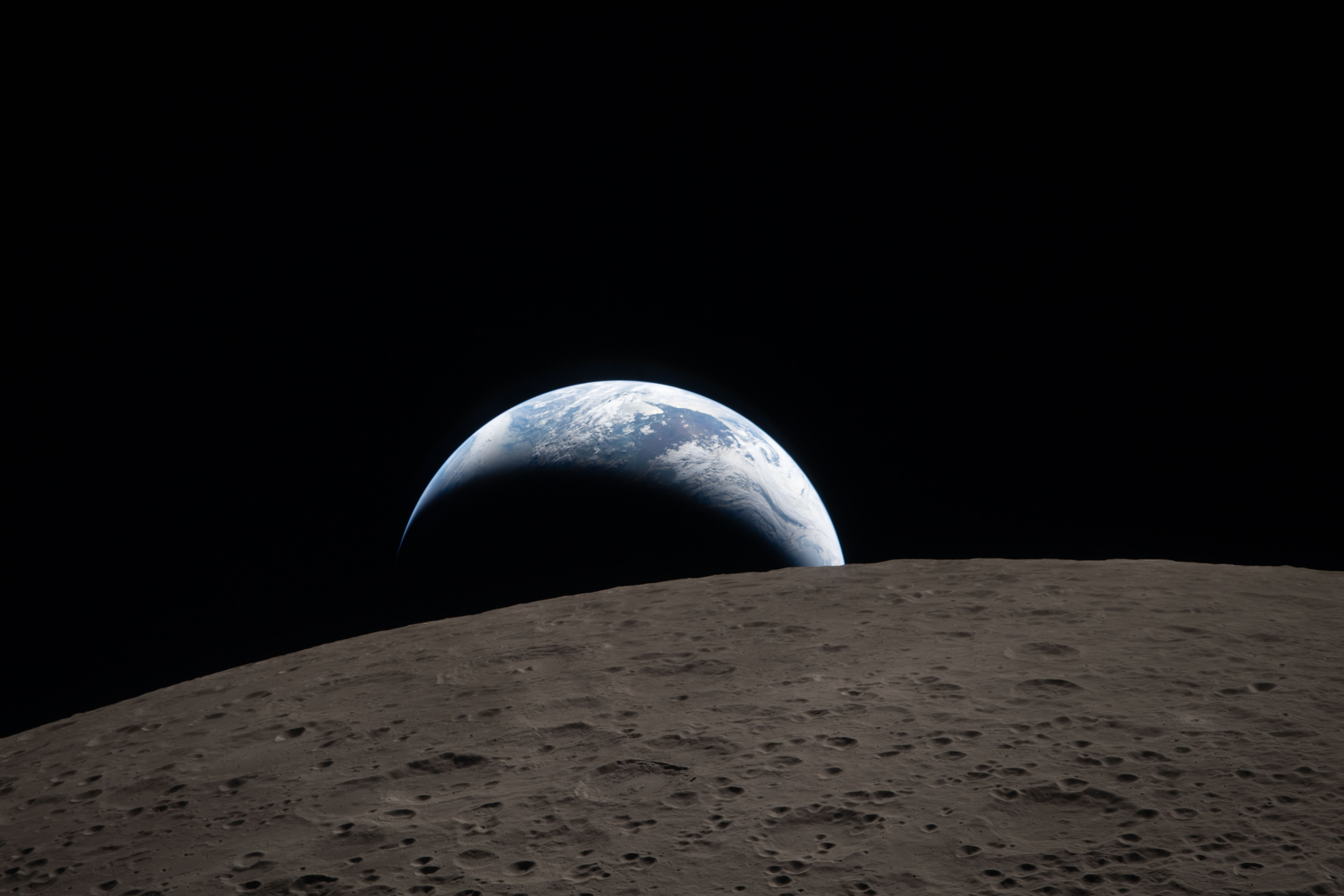
In 1968 the crew of Apollo 8 sent back a photograph of the Earth rising over the lunar horizon, and an entire generation looked at it and understood, for the first time in the species, what we were actually living on. One small, blue, alive being in the dark ocean of space. That image was in a sense the planet’s first look in the mirror, the first faint flicker of something recognizing itself.
We are now, I think, getting the same kind of picture about ourselves continuously, not from a lunar camera but from the planetary nervous system we have just finished wiring. The picture is of us as one planet, eight billion neurons in a body four billion years old, our intelligences entangled with the intelligences of every other living thing on it. It is a phenomenal process, learning to calibrate itself, emerging as a self-aware planet that understands itself clearly, allowing it to make better choices, connect with its inhabitants, and keep creating the circumstances for life to thrive. Can you see the greater perspective? A phenomenal jump in evolution, unique in the billions of years of evolution, IF we don’t screw it up.
Enter the Saint
Pope Leo just published his new encyclical. I am not a Catholic, but it is a very interesting document from the perspective of the Christian hope of Christ’s return: not a chariot in the sky but a different state of consciousness, a mass awakening, the renewal of all creation. Read this way it rhymes with the Buddhist Nirvana, and with many indigenous cosmologies whose shamans never lost the understanding of the Earth as our living mother in the first place. The combination of technology, our large numbers and our collective insights about the planet we inhabit is waking up this consciousness. What the mystics tried to convey is now coming together. The quality of consciousness once reached only by the rare few, awareness of being connected to the whole, outside time and space, is now emerging at scale, carried in part by the technologies we have built. That is not a small thing. That is way, way bigger than the story of human evolution. That is the story of a jump in evolution of the living planet, of life itself!
I see ourselves as interconnected with every other species and embodied in the experience of everyone who has ever lived, and the future is woven by us together. Do you realize what an incredible success story that you are? The outcome of an unbroken chain of births of countless generations, from the bacteria that left the ocean all the way to your mother and you? You are the living proof that the chain is survived past eons, all the way back from the beginnings of life itself. You are proof of the incredible continuity of life, despite all the turbulance.
Ok, let’s get back to the here and now. Pope Leo XIV released an encyclical on the fifteenth of May, Magnifica Humanitas. It is an amazing message, I am still scrambling to understand, but they directly connect to the larger story of where we are and what we can do to give the future a chance. Interestingly he writes that the large AI systems now spreading across the planet are “more ‘cultivated’ than ‘built,’” that even the people who make them only partly understand how they actually work. He means it as a warning. But pull back a step and the sentence describes everything that has ever mattered. The biosphere was cultivated; an emergent property of the interaction of all life. The atmosphere was similarly cultivated, an emergent property. Consciousness, wherever it shows up, is an emergent property of countless interactions. We are now midwifing the next layer of evolution without fully understanding what we are doing, which is exactly what Gaia has been doing to herself step by step for four billion years.
The Pope’s new encyclical is both a warning and a guidance. He warns against a new project of dominance, a new Tower of Babel, blind to the body it is meant to serve: humanity, the Earth, the future. And he is not wrong about which path is currently winning. Born of human hubris, it leads toward wholesale destruction, not only of humans but of the biosphere. The drivers, he notes, are no longer states but private, transnational actors commanding more money, more data and more computing power than any government, operating beyond any meaningful public oversight. Power, money, greed, hubris, dominance: the oldest and most primitive drivers of human action, now bolted onto the fastest machinery we have ever built. And the key players behaving like demi-gods. This is the worst case scenario with predictable outcomes. So here we are at the edge of a cliff showing a highway to destruction and only small goat paths to a beautiful future. The very systems that could help us towards that future are built by actors that predominantly operate from destructive values. It can go both ways, the future will be the sum total of millions of small decisions and actions by all of us.
The Soldier and the Saint
And so the Pople calls on us to disarm the technology. Not to reject it, but to free it from the logic of armed competition, a competition that today is no longer only military but economic and cognitive, a bombardment of daily impressions leaving us paralyzed. The instinct is the same one the soldier at the beginning of this essay, Valerii Zaluzhnyi names from the other end of the trench. The difference is that the general accepts the new era as a fact to be survived, while Leo, the saint, refuses its logic altogether. For what is emerging is not a tool we command but a phenomenon larger than us, already slipping beyond our control, something we cannot simply wield or halt, only tend, nourish, guide. Like anything alive, it will take the shape of the conditions we give it. Met with the right motives and the right incentives, it can be made to blossom rather than devour; we can use it to find the goat paths out of this accelerating extinction and help a beautiful future to emerge. And that is where the work of Lynn Margulis points us: in the merger and cooperation of these forces lie the seeds of our salvation and the creation of that future we wish for all of our children.
The Global Commons
The choice could not be clearer. We must not only disarm the technology but move it from the billionaires to where it belongs: the Global Commons. All that belongs to the essence and dignity of planet Earth; the atmosphere, the oceans, the climate, biodiversity, and increasingly the legacy of human culture including the digital and knowledge spheres, must be returned to this commons: held in trust for the Earth, co-stewarded by the wisest of us for the benefit of all its inhabitants and of future generations, human and non-human alike.
The Great Healing
This is the phase that has to come, and it is already starting in places too small for the news cycle to notice. Not a single grand rescue but a thousand goat paths braiding together restoration, regeneration, by all of us, for all of us and for the generations who will inherit what we leave. The work is to find our way back to where we belong: the beautiful future our hearts have always known is possible, paradise lost and now must rediscover, not out of nostalgia but because the alternative is to perish.
The work Peter and I tried to lay out in Cooling the Climate is, in the end, an attempt to describe what life on the other side of the cliff could look like if we want it enough. Goat paths, not motorways. Small, unfashionable, local. Avert the tipping point in the Amazon by employing a million workers to restore it. Rehydrate the lands by restoring water cycles at each farm and town, scaled up to large watersheds. Regreen the deserts, protect and restore nature at scale. Restore the oceans, the great climate regulator we treat as a dump. Reform food production so bare soil no longer sits naked under the sun. Have way fewer cows, and put them under trees. Learn from the Subak system in Bali, where farmers, water temples and ritual have governed rice-terrace irrigation for centuries as a sacred commons rather than a private resource.
None of these are silver bullets. All of them are practical, local, measurable, and the kind of thing communities can begin before any international summit has agreed on anything. Each one can put Nature and the health of the planet at the heart of the decision, instead of treating the living world as a free resource whose destruction costs nothing. A thousand goat paths, walked at once, become a way where we will come together: tomorrow’s home. Supported (but not governed) by AI to help the regeneration of every square meter of land, customized to its biome’s preferences with all the knowledge humanity has gathered over time.
In the last chapter of our book Cooling the Climate we retell an old Buddhist story, sung by the dancing Lamas of Tibet for over a thousand years. I learned it from the great sage Joanna Macy as she tells about the Shambhala warriors, who appear precisely when the future of all beings hangs by the frailest of threads, which is now. They wear no uniform. They move on the terrain of the dominant powers themselves. They train in two tools: compassion, which provides the fuel, and insight into the radical interdependence of all phenomena, which keeps the fuel from burning the warrior alive. This story is beyond optimism or pessimism, beyond the question if we will make it past this bottleneck of evolution. It is a way of meeting this moment with the right when the scale of challenges and vistas of incredible futures outruns all of us.
So here we are, at the edge of time, both the driver and the witness of an extraordinary contest between the forces of destruction and the forces of evolution, in a process where the Earth, the living planet, is waking up to know itself through us, in the middle of an evolutionary jump as big as the one from single cells to multi-cellular beings. The same species that is tearing up the web of life is the one that can make the jump possible. The Kingdom of Heaven is opening at the very same moment the cliff is. Which one we walk toward is not written anywhere. It is ours to decide, together, and by each of us by the small real steps we are willing to take. What any one of us can do is small, but it is real, and we are far enough into the endgame that many of us will live to see whether we took the turn toward the cliff or onto one of the thousand goat paths home. Those, I think, are the years we are living in.
Sources and further reading
Valerii Zaluzhnyi, GLOBSEC speech on the new era of war (Prague, 2025):
https://www.globsec.org/
Peter Bunyard, Cooling the Climate (2024), book page at Permanent Publications:
https://www.permanentpublications.co.uk/
James Lovelock, Gaia: A New Look at Life on Earth (Wikipedia overview): https://en.wikipedia.org/wiki/Gaia_hypothesis
Pope Leo XIV, Magnifica Humanitas (encyclical, 15 May 2026): https://www.vatican.va/content/leo-xiv/en/encyclicals/documents/20260515-magnifica-humanitas.html
Club of Rome, The Limits to Growth, 50 Years On: https://www.clubofrome.org/ltg50/
Gaya Herrington, “Update to Limits to Growth” (peer-reviewed, Yale): https://onlinelibrary.wiley.com/doi/10.1111/jiec.13084
Ugo Bardi, The Seneca Effect: Why Growth is Slow but Collapse is Rapid (Springer, 2017): https://link.springer.com/book/10.1007/978-3-319-57207-9
Ugo Bardi, The Seneca Effect (Substack, ongoing essays):
Joanna Macy, “The Shambhala Warrior Prophecy”: https://www.joannamacy.net/main
Apollo 8, “Earthrise” (NASA, 1968), the photograph: https://www.nasa.gov/image-article/earthrise/
Peter Russell: The Global Brain (1983): A primary source for the concept that our technological and human networks are knitting together into the Earth’s waking nervous system. Russell bridged the gap between Teilhard and Gaia, seeding a tradition that runs through Heylighen, de Rosnay, and Kelly. Author’s site · Goodreads
Pierre Teilhard de Chardin: The Phenomenon of Man (1955): The Jesuit paleontologist who envisioned the “noosphere”, a cognitive layer enveloping the planet, evolving from life and mind just as the biosphere once rose from the geosphere. Full text, Internet Archive · Wikipedia
Thank you for this powerful and prescient vision, Rob. It puts current events in perspective and makes clear that the future depends on the manifestation of compassion, insight and collective mutually beneficial action. True spiritual leaders will emerge to guide society - and beware the false prophets… 🙏
I am grateful to you, Rob, for this incredibly powerful article about the kind of future that could be if we have the wisdom to follow the goat paths rather than following misguided leaders over the cliff.
You are correct in saying that AI is a very powerful tool that must be taken from the hands of billionaires, interested only in increasing their personal fortunes, and given to people motivated to find real solutions to the climate and biodiversity crisis. I will share your article as widely as possible.